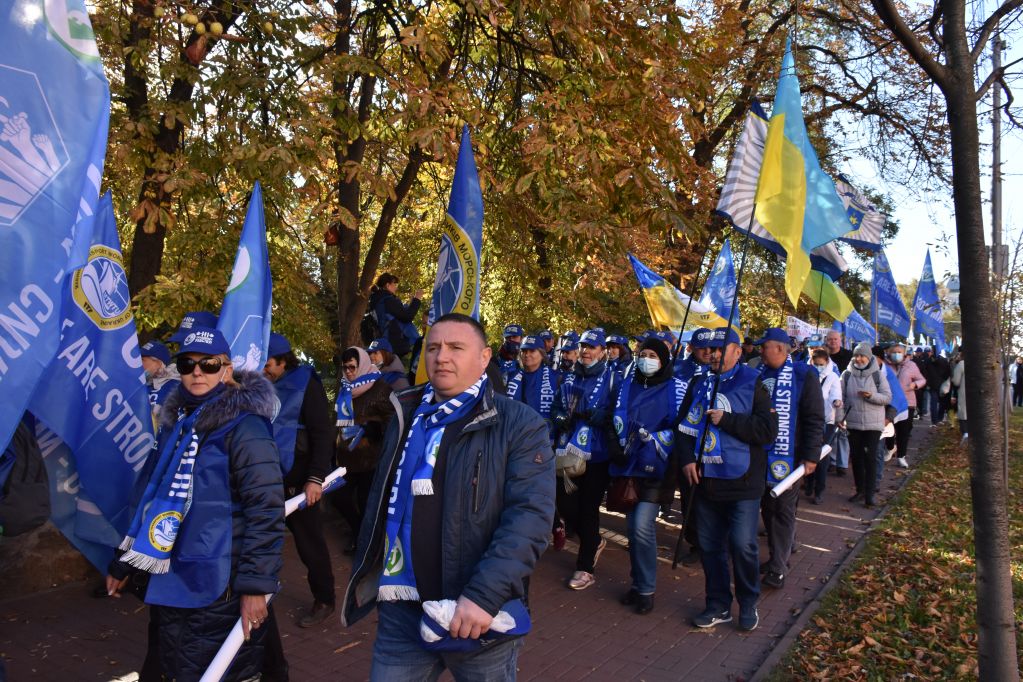


Belgian trade union magazine De Nieuwe Werker, published by one of the country’s largest trade union federations, ABVV-FGTB, has published an interview with MTWTU Chairman Oleg Grygoriuk.
In his conversation with Belgian colleagues, he spoke about how the work of the Ukrainian Trade Union has changed over the years of the full-scale war, the challenges faced by seafarers and port workers, how MTWTU protects labour rights under martial law, and the role of international trade union solidarity today.
Five years ago, when Oleg Grygoriuk was elected Chairman of the Ukrainian maritime trade union, the country was still dealing with the COVID-19 pandemic. Not long afterwards, Ukraine was confronted with a full-scale war.
As Chairman of the Marine Transport Workers' Trade Union of Ukraine, which represents around 80,000 seafarers, port workers and other maritime transport professionals, Oleg has witnessed how the outbreak of war fundamentally changed people's lives — and, with it, the work of the trade union itself.
"Looking back, it is clear that the pandemic was only a preparation for far greater challenges," he says.
No Access to Work
The first major blow for Ukrainian seafarers came immediately after russia's full-scale invasion. Following the introduction of martial law, men aged 18 to 60 were prohibited from leaving Ukraine. For seafarers, this meant they could no longer join vessels and go to sea.
No voyage meant no income. Overnight, thousands of families lost their primary source of livelihood.
The Trade Union immediately switched to crisis-response mode. Humanitarian assistance was organised for MTWTU members who had suddenly been left without a means of supporting their families. At the same time, legal support was provided to those who, under specific conditions, were still eligible to travel abroad for employment.
Oleg Grygoriuk explains, "For us, it was essential to do everything possible to ensure that people were not left without support or without hope for the future."
Ports Under Fire
As the war continued, the challenges became even greater.
The ports of Odesa, Chornomorsk, Izmail and other Ukrainian port cities have come under attack almost daily. Missile and drone strikes pose a constant threat to the lives of people working in the maritime sector. Some Trade Union activists have been killed, while others have been injured.
Another major challenge was prolonged power outages. In December, Odesa endured nearly two weeks of a complete blackout.
To ensure that support for its members continued uninterrupted, MTWTU invested in generators and alternative power supplies for its local organisations, enabling them to maintain their operations despite the difficult conditions.
During this period, international solidarity proved decisive.
According to Oleg Grygoriuk, European and global trade union organisations provided financial, logistical and legal assistance. Without this support, continuing the Union's work would have been far more difficult.
An Economy Under Pressure
Ukraine's economy has suffered enormous losses, although it has not come to a standstill. Many sectors continue to operate, particularly those supporting the country's critical exports. At the same time, Ukraine remains heavily dependent on international assistance.
In ports whose operations have been disrupted by the blockade or occupation, workers have at times gone unpaid or experienced significant delays in receiving their wages.
"We are engaged in constant dialogue with employers and public authorities to ensure that enterprises can continue operating and that workers have at least a minimum guaranteed income. It is impossible to compensate for these losses fully, but we are doing everything we can to prevent the worst consequences," says Oleg Grygoriuk.
Protecting Workers' Rights
During wartime, political priorities inevitably shift. Labour rights are no longer at the forefront of public attention. For MTWTU, however, protecting workers' rights remains one of its core responsibilities.
Whenever employees are unfairly dismissed or their rights are violated, the Union first seeks to resolve the issue through dialogue and negotiations. If that proves unsuccessful, the case is taken to court.
Over the past few years, dozens of legal cases have been initiated, with the majority resulting in favourable outcomes for workers.
"People need to see that the rule of law continues to function in Ukraine even during wartime. Social dialogue has not stopped. We continue to negotiate, defend workers' rights and do everything we can to ensure their voices are heard," says Oleg Grygoriuk.
Workers on the Front Line
Many MTWTU members are currently serving in Ukraine's Defence Forces, protecting the country.
After completing their military service, they are eligible for veteran status, although the process is often lengthy and complicated.
The Trade Union provides these members with legal assistance and, whenever possible, financial support.
War places an enormous burden on society. Daily life in Ukraine is marked by danger, constant stress and uncertainty.
Yet, according to Oleg Grygoriuk, what prevails among people is not despair but the determination to move forward.
"We cannot afford to lose hope. People want peace, and I am convinced that peace will come."
Life Today
Oleg Grygoriuk leaves geopolitical assessments to political and security experts.
For the Trade Union, the priority remains the everyday needs of its members: protecting people, helping to secure their livelihoods and defending their rights.
Making long-term predictions in the face of constant uncertainty is extremely difficult.
There is, however, one thing that remains unchanged — optimism as a conscious choice.
"If we, as a trade union, lose faith, then who will keep it alive? We must set an example for others. We have to show that solidarity is stronger than war."